Alumni Spotlight: Donato Riccardi — DBA, Commercial Consultant, Italy
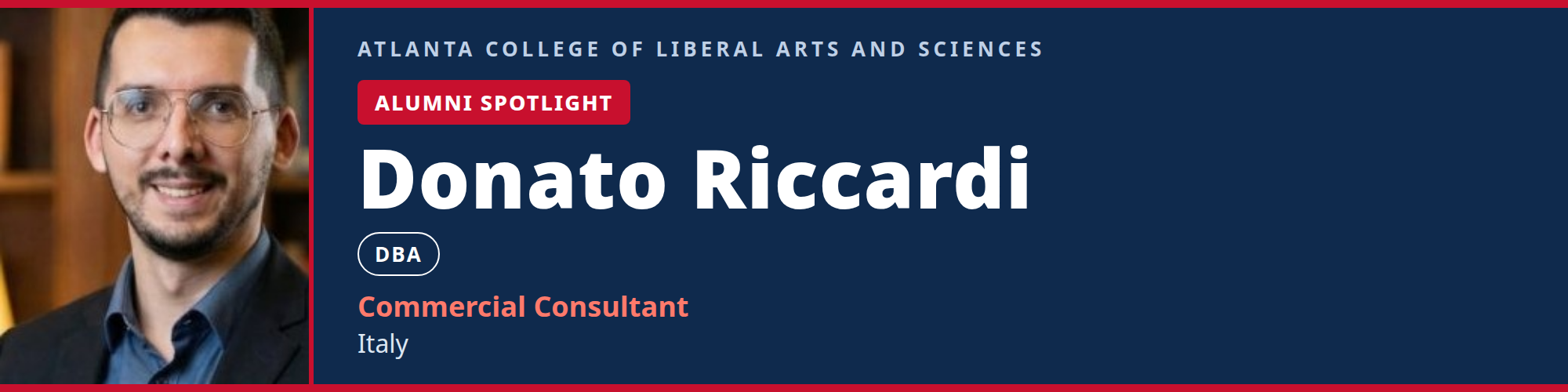
Donato Riccardi works in commercial consulting in Italy — a role where the questions change with every client. He completed his Doctor of Business Administration (DBA) at ACLAS while working. The story ACLAS's LinkedIn page told about him is not about leaving consulting behind, but about what a working consultant gains when advanced study is built to fit around the work, rather than the other way around. His feature's theme is a practical one: flexibility, and the academic support that makes the work–study balance hold.
"As a Commercial Consultant, he has demonstrated exceptional professionalism, strategic insight, and leadership in driving business growth and operational excellence. Throughout his role, he successfully achieved significant milestones in management by leading cross-functional teams, optimizing sales strategies, and improving overall workflow efficiency."
— as featured on his Alumni Spotlight poster
Flexibility that fits a working consultant's life
The first thing to notice is what his story does not ask of him. A commercial consultant's calendar belongs to clients: meetings move, deadlines compress, and a week that looked open on Monday can be full by Tuesday. A programme demanding fixed hours in a fixed place would be a second full-time job competing with the first — the point at which study stops being an option for most working professionals.
The DBA at ACLAS is self-paced and 100% online over one to three years, and can be started at any time. That is the answer to the consultant's calendar problem: study happens in the gaps the work leaves, not in slots it has to surrender. The LinkedIn feature names flexibility as the theme for a reason: it is not a convenience, but the condition that makes the whole thing possible.
Flexibility on its own, though, can leave a student isolated. The feature pairs it with academic support, and the pairing matters: a flexible programme with no support is just a pile of material and a deadline. Support turns flexibility into progress — someone to ask, a way to know whether the work is on track. For a consultant used to being the person with the answers, that is what keeps study from becoming a solitary late-night exercise with no feedback.
What the work itself shows
The poster does not describe Riccardi's study in the abstract. It describes what his work looks like — three things, worth taking one at a time.
Leading cross-functional teams is the first. In consulting, the teams that matter rarely report to you: they are assembled across functions and organisations with their own priorities, and the consultant's job is to get them moving in the same direction without the authority to order it. That is leadership without a hierarchy — influence and alignment, making a shared goal feel like everyone's goal.
Optimizing sales strategies is the second. A sales strategy is a hypothesis about what clients will pay for and why; optimizing it means testing that hypothesis against reality — which offers land, which stall, and what has to change. It is analytical work that ends in a measurable commercial result.
Improving overall workflow efficiency is the third — the least glamorous and often the most valuable. Efficiency is not about working faster; it is about removing the steps that should never have been there. A consultant who can simplify a workflow is doing in a client's business what a DBA asks a student to do in their own thinking: find the structure underneath the noise, and make it work better.
Together, the three add up to a particular kind of professional: someone who can lead people he does not manage, sharpen the commercial argument, and leave the operation simpler than he found it. That is the profile the DBA is built to develop — the outcome of the study, not just the background he brought to it.
For readers considering the same path
If you work in consulting — or in any role where the calendar belongs to someone else — here are three practical takeaways from Riccardi's example:
- Fit the study to the work, not the other way round. A programme demanding fixed hours will lose to a working week every time. Self-paced, fully online study is what makes an advanced degree possible for someone whose diary is not their own — so check that fit first, rather than hoping the work will quieten down.
- Treat support as part of the programme, not an extra. Flexibility without support is isolation. When you compare programmes, ask who answers when you are stuck and how quickly — that is what carries you through the weeks when the work is heavy and study would otherwise be dropped first.
- Judge the study by what changes at work. The test is not a grade. It is whether the study shows up in the work: teams led better, strategies sharpened, workflows simplified. If a programme cannot point to that kind of change, it has not done its job — whatever the certificate says.
None of this makes the path easy. It makes it possible — which, for a working consultant, is the point.
Want to be our next Alumni Spotlight?
Riccardi's story was first shared on ACLAS's LinkedIn page around December 2025 – January 2026. If you are an ACLAS graduate with a story to share, submit yours through the Alumni Spotlight page at spotlight.aclas.college — new graduates are invited to take part, and selected stories will be featured here.
The DBA is $199 one-time (covers the total cost, no additional fees); Plan A is 4 instalments totalling $207 and Plan B is 2 instalments totalling $203; 14 courses, 210 credits, 1–3 years self-paced and 100% online — see https://aclas.college/programs/dba. Entry needs a master's degree or equivalent and English reading, writing and speaking.
Comments
Post a Comment