Alumni Spotlight: Laly Noya Rakotoniaina — DBA, High-School Business Teacher
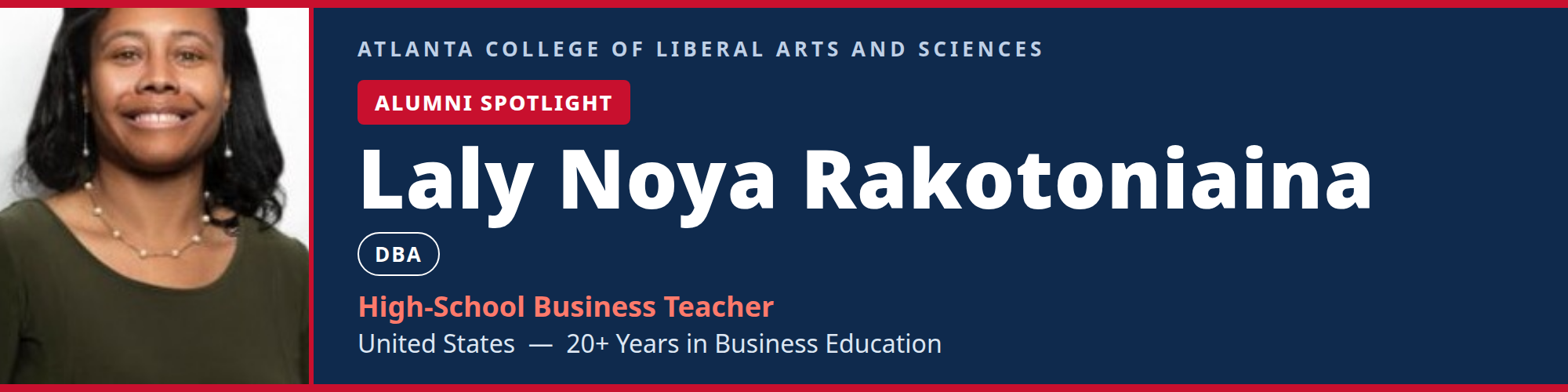
Most people imagine a doctorate as the start of a career. For Laly Noya Rakotoniaina, it came after more than twenty years of one. A high-school business teacher in the United States, she has spent over two decades teaching young people how business works — and then she went back to study it herself, completing a Doctor of Business Administration (DBA) at ACLAS. Her story is about what further study is for when the student already stands in front of a classroom: not a new career, but a deeper one, and the confidence to lead in education from a position of having done the learning herself.
"With over 20 years in business education, this DBA graduate advanced their leadership and expertise through ACLAS's flexible, career-focused doctoral program."
— as printed on her Alumni Spotlight poster
Twenty years in the classroom — and still a student
There is a particular kind of courage in going back to study after twenty years of teaching. A teacher with that much experience has nothing left to prove in the classroom; the students already listen, the lessons already work. Choosing a doctorate at that point is not about filling a gap. It is about refusing to stand still.
That is the first thing Laly's story says, and it is worth pausing on. Twenty years in business education means twenty years of watching the subject change — new tools, new markets, new expectations of what a graduate should know. A teacher who stops learning in that environment slowly starts teaching the past. A teacher who keeps learning stays current, and the students notice. The doctorate, in that light, is not a departure from teaching. It is part of teaching: the same habit of learning, carried one level further.
It also changes what a teacher can say with authority. Business is a subject where credibility matters — students can tell the difference between a teacher who repeats a textbook and one who has wrestled with the material at the highest level. A DBA does not make someone a better teacher by itself. But the study behind it — the reading, the analysis, the demand to think at doctoral level — gives a teacher more to draw on, and more confidence in what she draws on.
A doctorate built around a teacher's working life
The second theme of Laly's story is how the study fitted around the job. Her poster's own words point to it directly: a "flexible, career-focused doctoral program". For a full-time teacher, that flexibility is not a convenience. It is the condition that makes the study possible at all. A school timetable does not bend around a university's schedule; a programme that insists on fixed hours would simply exclude the people who teach during them.
The LinkedIn feature that introduced her makes the same point from the other side: flexible, online, career-oriented doctoral study, and what it does for confidence in educational leadership. That last phrase matters. Leadership in a school is not only about titles. It is about the confidence to make decisions — about curriculum, about students, about direction — and to stand behind them. Study that is genuinely career-focused builds that confidence, because the learning connects directly to the work: the ideas are tested against real classrooms and real students, not kept in the abstract.
"Advanced their leadership and expertise" is the poster's summary, and it is carefully chosen. Leadership and expertise, together. The doctorate did not only add knowledge; it advanced the ability to lead with it. For a teacher, those two things cannot be separated for long — expertise without leadership stays in the classroom, and leadership without expertise is guesswork.
For readers considering the same path
If you teach — or if you work in any profession where you guide other people — Laly's story offers three practical takeaways, not as advice from her, but as what her example demonstrates:
- Experience is a reason to study, not a reason to stop. Twenty years in a profession does not make further study unnecessary; it makes it more valuable, because every new idea lands on twenty years of practice to be tested against.
- Fit the doctorate around the job you already have. A programme that demands you pause your career will exclude the people with the most to bring to it. Flexibility and online delivery are what let a working teacher study at doctoral level at all.
- Study for the room you already lead. The most useful further study for a teacher is aimed at live questions: the students already in front of you, the colleagues you already work with, the school you already serve. That is where the learning earns its place — and where confidence in educational leadership is actually built.
None of this makes the path easy. It makes it purposeful — which, for a working professional, is the real question.
Want to be our next Alumni Spotlight?
Laly's story was first shared on ACLAS's LinkedIn page in February 2026. If you are an ACLAS graduate with a story to share, you can submit yours through the Alumni Spotlight page at spotlight.aclas.college — new graduates are invited to take part, and selected stories will be featured here.
The DBA is $199 one-time (instalments available: Plan A 4 payments of $30, $40, $50 and $79, plus $2 per payment, $207 total; Plan B 2 payments of $60 and $139, plus $2 per payment, $203 total), 14 courses, 210 credits, 1–3 years self-paced and 100% online — see https://aclas.college/programs/dba. DBA entry needs a master's degree or equivalent and English reading, writing and speaking.
Comments
Post a Comment