Alumni Spotlight: Dr Mohammad Altaf Madraswala — DBA, Founder & CEO, Madraswala Group of Companies
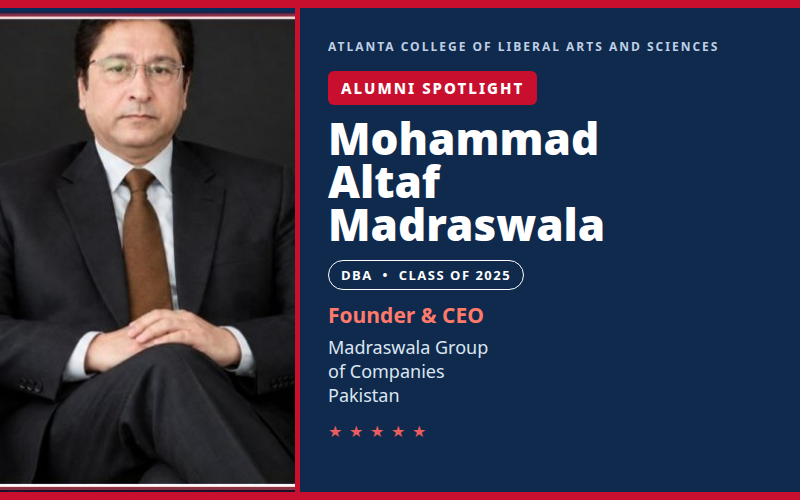
Some careers are measured in years. Dr Mohammad Altaf Madraswala's is measured in decades — about four of them, spent in insurance and banking in Pakistan, before he founded his own group.
Madraswala, a 2025 Doctor of Business Administration (DBA) graduate of ACLAS, is Founder & Chief Executive Officer of the Madraswala Group of Companies (MGC), a financial and management advisory and consultancy group. Before that, he was Executive Director (RHQ) & Head of Operations at the National Insurance Company Limited (NICL). His was the third-most-recent alumni post on ACLAS's LinkedIn page, published in late October 2026, and it captures a question that comes up often for senior professionals: after a long career, what does further study actually add?
"The ACLAS courses provided me with an opportunity to connect academic concepts with real-life professional experiences. I learned that effective leadership is not only about authority, position or technical expertise; it is about influencing people positively, building trust, managing change and creating sustainable value. My ACLAS journey has therefore been more than an academic experience — it has been an opportunity for reflection, reinvention and preparation for the next chapter of my leadership journey." — Dr Mohammad Altaf Madraswala, DBA, as featured on his Alumni Spotlight poster
Leadership, tested by change
The theme of Madraswala's LinkedIn feature was leadership, and in insurance and banking that word has a practical meaning. Four decades in the sector teach you something a course alone cannot: leadership is tested when change arrives, not when things are calm. A leader in that world is judged by how people are influenced, how trust is built, and how value is created over time — not by the authority printed on a business card.
That is the distinction his story draws. Effective leadership, as he puts it, is not only about authority, position, or technical expertise. It is about influencing people positively, building trust, managing change, and creating sustainable value. Those are not slogans from a textbook. They are the habits that decide whether an organisation survives a difficult period intact — and whether the people in it keep following the person in charge.
From practitioner to founder
The second theme of his feature was what study does for someone who already has the experience. After a career at NICL, Madraswala founded his own advisory group — a move from running operations inside a large institution to building a business of his own. Doctoral study did not supply the four decades of experience. What it supplied, in his own words, was the chance to connect academic concepts with real-life professional experience — and, through that, reflection, reinvention, and preparation for the next chapter.
That framing matters for readers who are further along in their careers. A DBA at that stage is not a first step. It is a way to step back from daily operations and examine them: to put a name to patterns seen over many years, to test them against frameworks, and to return to work with a clearer sense of why a decision works, not just how it is made. For a founder, that clarity is the product — the advice clients pay for is judgement, and judgement improves when experience is examined rather than only accumulated.
For readers considering the same path
If you are a senior professional wondering whether doctoral study is realistic — or worth it — after a long career, Madraswala's story offers three practical takeaways — not as advice from him, but as what his example demonstrates:
- Use your workplace as your laboratory. The strongest doctoral work for a practitioner draws on problems already in front of them — operations, compliance, teams, and clients — rather than invented case studies.
- Measure leadership by trust, not by title. Authority and expertise open doors, but the test is whether people are influenced positively, trust is built, and value is created and sustained.
- Treat study as preparation for the next chapter, not a reward for the last one. A degree completed after a long career is a long commitment. Its value shows in how decisions are made afterwards, not only in the certificate itself.
None of this makes the path easy. It makes it possible — which, for a working professional, is the real question.
Want to be our next Alumni Spotlight?
Madraswala's story was first shared on ACLAS's LinkedIn page in late October 2026. If you are an ACLAS graduate with a story to share, you can submit yours through the Alumni Spotlight page at spotlight.aclas.college — new graduates are invited to take part, and selected stories will be featured here.
The DBA is $199 one-time (instalments available: Plan A 4 payments of $30, $40, $50 and $79, plus $2 per payment, $207 total; Plan B 2 payments of $60 and $139, plus $2 per payment, $203 total), 14 courses, 210 credits, 1–3 years self-paced and 100% online — see the DBA programme page. Entry needs a master's degree or equivalent and English reading, writing and speaking.
相关阅读
- Alumni Spotlight: Lukas Erlebach — MBA & DBA, Founder & CEO, GlamCoding Erlebach s.r.o.
- Alumni Spotlight: Olatunji Esan — DBA, MD/CEO, Alveron
- Alumni Spotlight: William F. McKee — MBA & DBA, Professor, Winston-Salem State University
原文:Alumni Spotlight: Dr Mohammad Altaf Madraswala — DBA, Founder & CEO, Madraswala Group of Companies — Atlanta College of Liberal Arts and Sciences
Comments
Post a Comment