Alumni Spotlight: William F. McKee — MBA & DBA, Professor, Winston-Salem State University
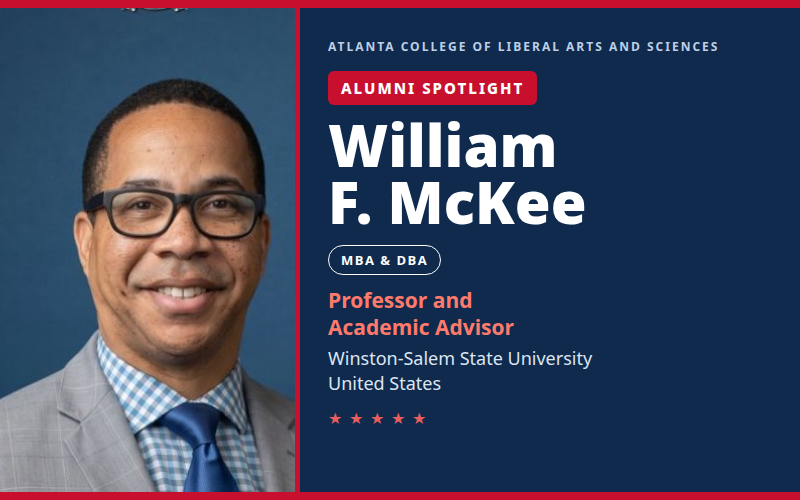
Most students study to change careers. William F. McKee studied to do the career he already had — better. A Professor and Academic Advisor at Winston-Salem State University in the United States, he completed both a Master of Business Administration (MBA) and a Doctor of Business Administration (DBA) at ACLAS while working in higher education. His story is about what further study is for when the student already stands in front of a classroom: not a credential to get a job, but the understanding to guide the students already sitting in front of him, and the strategic vision to lead in education.
"My experience at ACLAS has been one of meaningful growth and purposeful challenge. The structure and content of the DBA program provided a distinctive pedagogical experience that was both intellectually rewarding and deeply enriching. The rigor of the program strengthened my understanding of business administration and has already translated into measurable benefits in my professional life."
— William F. McKee, MBA & DBA, as featured on his Alumni Spotlight poster
Growth that is purposeful, not just busy
The first thing McKee says about his study is that it was not merely demanding — it was purposeful. "Meaningful growth and purposeful challenge" is a careful pair of words: the challenge had a point, and the growth could be named. For a working academic, that distinction matters. A professor's calendar is already full; another programme only earns its place if the effort goes somewhere.
He puts the reason in the programme itself: its structure and content. Not a single inspiring lecture, but the way the whole programme was put together — the order of things, what was asked of him, and how the material was delivered. He calls that a "distinctive pedagogical experience", which is the language of someone who teaches for a living and notices how teaching is done. A student who has never taught might call a programme good; a professor notices the pedagogy, and says whether it works.
And he says it worked in two ways at once: intellectually rewarding and deeply enriching. The first is about the mind — the ideas were worth wrestling with. The second is about the person — the study added something that stayed. That is the test he applies, and it is a stricter one than a grade: did the learning change how he understands his field?
Rigor that shows up at work
The second theme is what that understanding did once he had it. McKee does not describe the DBA as an ornament for a CV. He says its rigor "strengthened my understanding of business administration" — and then, in the same breath, that it "has already translated into measurable benefits in my professional life". The word "already" does a lot of work there: the benefit did not wait for graduation day. It showed up while the study was still under way.
That is the natural frame for a doctorate taken by someone who works in education. A professor and academic advisor deals daily with the same questions a business programme teaches: how organisations are run, how people are led, how plans are made and carried out. When the study is rigorous, the understanding it builds does not stay in the textbook — it goes into the advising meeting, the classroom, and the decisions about how a programme is run. "Measurable benefits" is his word, not ours, and it is deliberately modest: he does not claim a promotion or a title, only that the work got better in ways that could be seen.
The LinkedIn feature that introduced him makes the same point from the other side: continued learning and strategic vision are what shape educational leadership. Study, in that frame, is not a break from the job. It is part of how the job is done well.
For readers considering the same path
If you work in education — or in any profession where you guide other people — McKee's story offers three practical takeaways, not as advice from him, but as what his example demonstrates:
- Judge a programme by its structure, not its syllabus alone. A list of courses tells you what is covered. What matters for a busy professional is how the programme is built — whether its structure and content fit around real work, and whether the teaching itself is worth a teacher's attention.
- Expect the benefit to show up before you finish. If the study is rigorous, you should not have to wait for the certificate to use it. The test McKee applies is whether understanding strengthens while you are still studying — and whether the difference is visible in your professional life.
- Study for the people you already serve. The most useful further study for an advisor or a teacher is aimed at live questions: the students you already advise, the colleagues you already work with, the institution you already serve. That is where the learning earns its place.
None of this makes the path easy. It makes it purposeful — which, for a working professional, is the real question.
Want to be our next Alumni Spotlight?
McKee's story was first shared on ACLAS's LinkedIn page in June 2026. If you are an ACLAS graduate with a story to share, you can submit yours through the Alumni Spotlight page at spotlight.aclas.college — new graduates are invited to take part, and selected stories will be featured here.
The MBA is $89 one-time, 8 courses, 120 credits, 1–3 years self-paced and 100% online — see https://aclas.college/programs/mba. The DBA is $199 one-time (instalments available: Plan A 4 payments of $30, $40, $50 and $79, plus $2 per payment, $207 total; Plan B 2 payments of $60 and $139, plus $2 per payment, $203 total), 14 courses, 210 credits, 1–3 years self-paced and 100% online — see https://aclas.college/programs/dba. Entry needs a master's degree or equivalent and English reading, writing and speaking.
相关阅读
- Alumni Spotlight: Lukas Erlebach — MBA & DBA, Founder & CEO, GlamCoding Erlebach s.r.o.
- Alumni Spotlight: Olaoluwa Malachi — MBA, AI Engineer, Canada
- Alumni Spotlight: Chase Neil — DBA, Natural & Complementary Health Entrepreneur
原文:Alumni Spotlight: William F. McKee — MBA & DBA, Professor, Winston-Salem State University — Atlanta College of Liberal Arts and Sciences
Comments
Post a Comment