Alumni Spotlight: Olaoluwa Malachi — MBA, AI Engineer, Canada
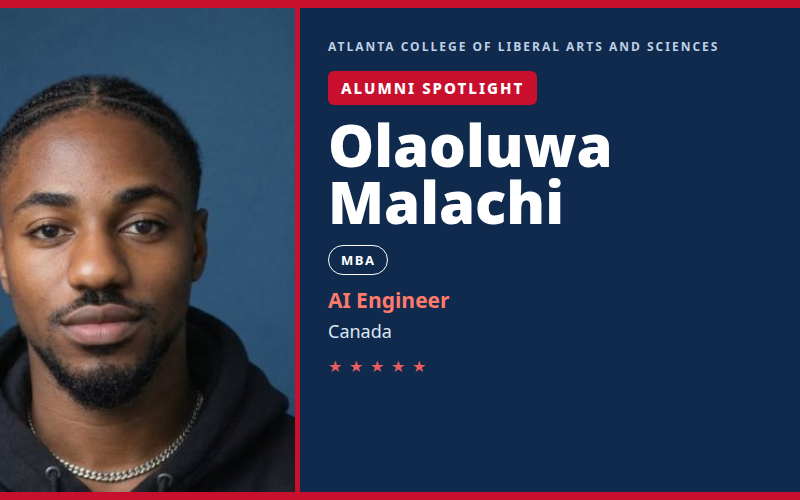
Most engineers are asked to build what someone else decided. Olaoluwa Malachi studied for the other side of that conversation: the part where the decision itself gets made. An AI Engineer in Canada, he completed his Master of Business Administration (MBA) at ACLAS while working in technology — not to leave engineering behind, but to carry his technical judgement into the room where strategy, budgets and priorities are set. His story is about what happens when the person who understands how a system works also learns how a business decides what to build.
"My experience with ACLAS was a positive one. The MBA program helped me sharpen my thinking around leadership, strategic planning, and financial decision-making, and it gave me a useful framework for applying business concepts more intentionally."
— Olaoluwa Malachi, MBA, as featured on his Alumni Spotlight poster
From building systems to shaping decisions
The first thing Malachi names is not a course or a certificate. It is a change in how he thinks. "Sharpen my thinking around leadership, strategic planning, and financial decision-making" is a list of three things an engineer is rarely trained in formally — and each one sits upstream of the work itself. Leadership decides who does what. Strategic planning decides what gets built at all. Financial decision-making decides whether it is worth building. An engineer who can only do the building is dependent on someone else getting those three calls right.
That is the gap the MBA filled for him, as he describes it. The programme did not teach him to code better. It gave him a way to think about the decisions that surround the code — and, just as importantly, a framework for applying business concepts "more intentionally". The word intentionally does the work there. It is the difference between knowing a concept and using it on purpose, at the right moment, for a reason you can explain. For someone whose job is to make systems behave predictably, that kind of deliberate application is a familiar standard, now applied to business rather than software.
The LinkedIn feature that introduced him makes the same point from the other side: his theme is combining technical expertise with executive-level strategy to produce measurable business value. The value is the test. Strategy that cannot be measured is only an opinion, and an engineer knows the difference.
A framework, not just a set of facts
Malachi is careful about what the programme gave him. He does not say it handed him answers. He says it gave him "a useful framework" — a structure he can carry into new problems, not a list of facts that goes stale when the problem changes. That distinction matters for anyone working in AI, where the tools change every year and the questions about what to build, and why, change with them.
A framework is what lets a technical person argue for a decision in business terms: this is the cost, this is the return, this is the risk, this is why now. It is also what lets them push back when a plan does not add up. Financial decision-making is not a subject most engineers study, but it is the language every budget decision is argued in. Malachi names it alongside leadership and strategic planning because the three belong together: lead the people, plan the direction, and make the numbers work.
That is also why his story is not a career-change story. He did not study to stop being an engineer. He studied so that the engineering judgement he already had would count where the decisions are made — and so that the value of the work could be shown, not just felt.
For readers considering the same path
If you work in technology — or in any field where you build things other people decide about — Malachi's story offers three practical takeaways, not as advice from him, but as what his example demonstrates:
- Learn the language of the decision, not just the craft. Technical skill gets the work done. Leadership, strategic planning and financial decision-making decide which work is worth doing. The MBA, for Malachi, was the second half of that pair.
- Look for a framework, not a fact sheet. Facts age fast in technology. What lasts is a way of thinking you can apply to the next problem — deliberately, and in a way you can explain to people who do not share your background.
- Measure the value. The test Malachi's story applies is whether the combination of technical expertise and strategy produces something measurable. If the study does not change what you can show for your work, it has not done its job.
None of this makes the path easy. It makes it deliberate — which, for an engineer, is the point.
Want to be our next Alumni Spotlight?
Malachi's story was first shared on ACLAS's LinkedIn page around March–April 2026. If you are an ACLAS graduate with a story to share, you can submit yours through the Alumni Spotlight page at spotlight.aclas.college — new graduates are invited to take part, and selected stories will be featured here.
The MBA is $89 one-time, 8 courses, 120 credits, 1–3 years self-paced and 100% online — see https://aclas.college/programs/mba. Entry needs a bachelor's degree or equivalent and the ability to study in English; no IELTS/TOEFL, GPA, work-experience, GMAT or age requirement stated.
相关阅读
- Alumni Spotlight: William F. McKee — MBA & DBA, Professor, Winston-Salem State University
- Alumni Spotlight: Samuel Flynn — MBA, Creative Media Coordinator, Holywood Studios U.S. P.C.
- Alumni Spotlight: Rasika D Niroshan — MBA, Manufacturing Accounts Manager, Dialog Axiata PLC
原文:Alumni Spotlight: Olaoluwa Malachi — MBA, AI Engineer, Canada — Atlanta College of Liberal Arts and Sciences
Comments
Post a Comment