Alumni Spotlight: Samuel Flynn — MBA, Creative Media Coordinator, Holywood Studios U.S. P.C.
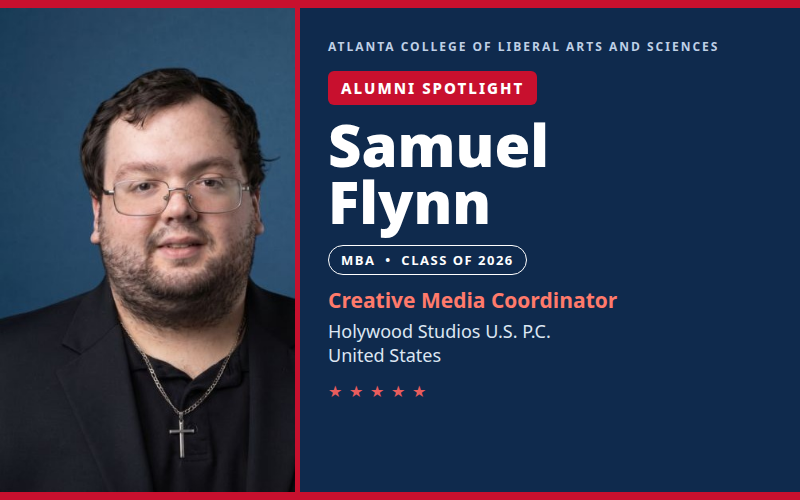
Creative work and business sense are often treated as opposite talents. Samuel Flynn's career says otherwise. As Creative Media Coordinator at Holywood Studios U.S. P.C., he brings together media production, technical skill, and ministry experience. In 2026 he completed his Master of Business Administration (MBA) at ACLAS, adding formal business study to experience he already had. His story is about what a degree is for when the student is already working in the field: not a first step, but a way of making the work he already does hold together better.
"My experience at Atlanta College of Liberal Arts and Sciences was great. The courses were easy to access online and very detailed, and I liked what I learned in Business Administration. I am glad to be a graduate of this school."
— Samuel Flynn, MBA, as featured on his Alumni Spotlight poster
Easy to access, detailed enough to use
The first theme of Flynn's story is the one his own words put first: access. The courses were easy to access online, he writes, and very detailed — and he liked what he learned in Business Administration. That sounds simple, and for a working creative it is the whole point. A media coordinator's week does not leave room for a study timetable that fights back. If the material is hard to reach, it does not get reached; if it is thin, it does not survive the working day.
His account says the courses cleared both bars. Easy access meant study could fit around the work; detail meant the study was worth fitting in. That is the test every working student applies, whether they say so or not: can I get to it, and does it hold up once I am there? For Flynn, the answer to both was yes.
There is a second point hiding in that short account. He did not come to the MBA empty-handed. His reflection notes that he already had some business experience — and the evidence he gives is public: he had been featured in magazines, naming Nashville Voyager, Canvas Rebel and Bold Journey, and talked about in 3nigma Bred Music Studio's blog in Louisiana. A student who arrives with that kind of record is not looking for a credential to start a career. He is looking for the structure behind the work he is already doing.
Creative work that runs on business sense
The second theme is what that structure is for. Flynn describes himself as bringing "a strong blend of media production, technical skill, and ministry experience" to the Holywood Studios team. That blend is the point. Media production is a craft; coordinating it is a management job. Someone has to keep the creative work, the technical work, and the people doing both moving in the same direction — and in a studio, that coordination is the work, not the interruption to it.
Ministry experience belongs in that blend too. It is work that runs on trust, on communication, and on getting people to pull together — the same capacities a coordinator needs when a production has a deadline and a dozen moving parts. Creative work done well is organised work, and organised work is a business skill.
That is where his account of the MBA lands. What he liked, he writes, was what he learned in Business Administration — the part of the degree that speaks directly to running things: how decisions get made, how work gets organised, how a creative operation stays on its feet. For a coordinator, that is not theory at a distance. It is the vocabulary for the job he already holds.
For readers considering the same path
If you are a working professional wondering whether further study is realistic alongside a demanding job, Flynn's story offers three practical takeaways — not as advice from him, but as what his example demonstrates:
- Judge a course by whether you can reach it and use it. Easy online access and detailed material are not luxuries for a working student — they are the conditions that decide whether study happens at all. If a course fails either test, it will not survive your working week.
- Study to organise the work you already do, not to start over. Flynn arrived with production experience, technical skill, and public recognition. The MBA gave him the business structure behind that work — the administration that turns creative talent into a running operation.
- Let different kinds of experience count together. Media production, technical skill, and ministry experience look unrelated on paper. In practice they are one skill set: making things, making them work, and getting people to pull together. Study that connects them is worth more than study that deepens only one.
None of this makes the path easy. It makes it possible — which, for a working professional, is the real question.
Want to be our next Alumni Spotlight?
Flynn's story was first shared on ACLAS's LinkedIn page in July 2026. If you are an ACLAS graduate with a story to share, you can submit yours through the Alumni Spotlight page at spotlight.aclas.college — new graduates are invited to take part, and selected stories will be featured here.
The MBA is $89 one-time, 8 courses, 120 credits, 1–3 years self-paced and 100% online — see https://aclas.college/programs/mba. Entry needs a bachelor's degree or equivalent and the ability to study in English; no IELTS/TOEFL, GPA, work-experience, GMAT or age requirement stated. 2- and 4-instalment plans are available.
相关阅读
- Alumni Spotlight: Lukas Erlebach — MBA & DBA, Founder & CEO, GlamCoding Erlebach s.r.o.
- Alumni Spotlight: Olaoluwa Malachi — MBA, AI Engineer, Canada
- Alumni Spotlight: William F. McKee — MBA & DBA, Professor, Winston-Salem State University
原文:Alumni Spotlight: Samuel Flynn — MBA, Creative Media Coordinator, Holywood Studios U.S. P.C. — Atlanta College of Liberal Arts and Sciences
Comments
Post a Comment