Alumni Spotlight: Chase Neil — DBA, Natural & Complementary Health Entrepreneur
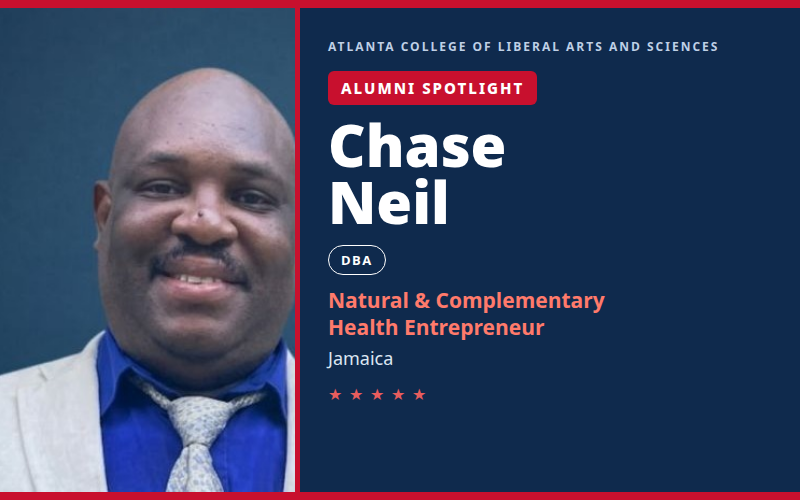
Some students study to leave their work behind. Chase Neil studied to run his better. A natural and complementary health entrepreneur in Jamaica — and, as the LinkedIn feature that introduced him puts it, Founder & Manager of Epic Counselling & Consultations — he pursued his Doctor of Business Administration (DBA) at ACLAS while running his own practice. His story is about what doctoral study is for when the student is already the boss: not a credential to get hired, but the skills to lead the team he already has, and to plan the business he already owns.
"ACLAS' innovative teaching-learning format allowed me to grasp concepts quickly. As a visual learner, I was able to read the lessons to understand the content, and the auditory delivery of lessons reinforced what I had assimilated. The courses bolstered my leadership skills so I can manage my own small business team, and it also helped me in better planning and executing my marketing and outreach plan."
— Chase Neil, DBA, as featured on his Alumni Spotlight poster
Learning in the way that sticks
The first theme of Neil's story is the one his own words put first: how the learning actually reached him. He describes himself as a visual learner — someone who understands by reading the lessons — and says the auditory delivery of those same lessons reinforced what he had assimilated. Two modes, one understanding: read it first, then hear it again, and the idea holds.
That sounds like a small detail, and for a working student it is the whole point. A practitioner running a business has no spare hours to wrestle with material that fights back. If a lesson cannot be grasped quickly, it does not get grasped at all. His account says the format cleared that bar: it let him grasp concepts quickly, in the mode that worked for him, then reinforced them in a second mode.
He did not praise the format in the abstract, but for what it let him do — understand the content, keep it, and carry it into the work. For a student studying alongside a practice, that is the only test that matters: does the learning survive the journey from the lesson to the working week? In his telling, it did — because it arrived in a form he could take in, and then came back a second way to make sure it stayed.
Study that serves the business you already run
The second theme is what that learning was for. Neil is not an employee waiting for a promotion. He runs his own small business — a counselling practice, and a natural and complementary health enterprise — which means the leadership skills he writes about are not preparation for a future role. They are the skills he uses on Monday morning, with the team he already manages.
That changes what a doctorate is for. The courses, he writes, bolstered his leadership skills so he can manage his own small business team — and helped him in better planning and executing his marketing and outreach plan. Those are two different jobs, and both belong to the same person: leading the people inside the business, and reaching the people outside it. A degree that helps with only one has only done half the work.
His account says the DBA helped with both. Leadership for the team, planning for the outreach — the study served the business as a whole, not just one part of it. That is the natural frame for a doctorate taken by someone who already runs something: the test is not whether the study was interesting, but whether the business runs better for it. In his telling, it does.
For readers considering the same path
If you are a working professional wondering whether further study is realistic alongside a demanding job, Neil's story offers three practical takeaways — not as advice from him, but as what his example demonstrates:
- Learn in the mode that sticks for you. Some people grasp a concept by reading it; others need to hear it, or hear it again after reading. A programme that teaches in more than one mode is not a luxury — it is what lets a busy student actually keep what they study.
- Study for the team and the business you already have. The most useful doctorate for a working owner is one aimed at live questions — leading the people you already employ, and planning the outreach you already need to do — not a credential kept for later.
- Judge study by whether the work runs better. If the team is better managed and the marketing plan is better executed, the study has earned its place — and that is the test to apply before you enrol.
None of this makes the path easy. It makes it possible — which, for a working professional, is the real question.
Want to be our next Alumni Spotlight?
Neil's story was first shared on ACLAS's LinkedIn page in June 2026. If you are an ACLAS graduate with a story to share, you can submit yours through the Alumni Spotlight page at spotlight.aclas.college — new graduates are invited to take part, and selected stories will be featured here.
The DBA is $199 one-time (instalments available: Plan A 4 payments of $30, $40, $50 and $79, plus $2 per payment, $207 total; Plan B 2 payments of $60 and $139, plus $2 per payment, $203 total), 14 courses, 210 credits, 1–3 years self-paced and 100% online — see https://aclas.college/programs/dba. Entry needs a master's degree or equivalent and English reading, writing and speaking.
相关阅读
- Alumni Spotlight: William F. McKee — MBA & DBA, Professor, Winston-Salem State University
- Alumni Spotlight: Rumaizi Bin Ahmad — DBA, NGO Chairperson and District Branch Chairman of Cooperative
- Alumni Spotlight: Hasanul Islam — DBA, Assistant General Manager (HRM), Liz Fashion Industry Limited
原文:Alumni Spotlight: Chase Neil — DBA, Natural & Complementary Health Entrepreneur — Atlanta College of Liberal Arts and Sciences
Comments
Post a Comment