Alumni Spotlight: Hasanul Islam — DBA, Assistant General Manager (HRM), Liz Fashion Industry Limited
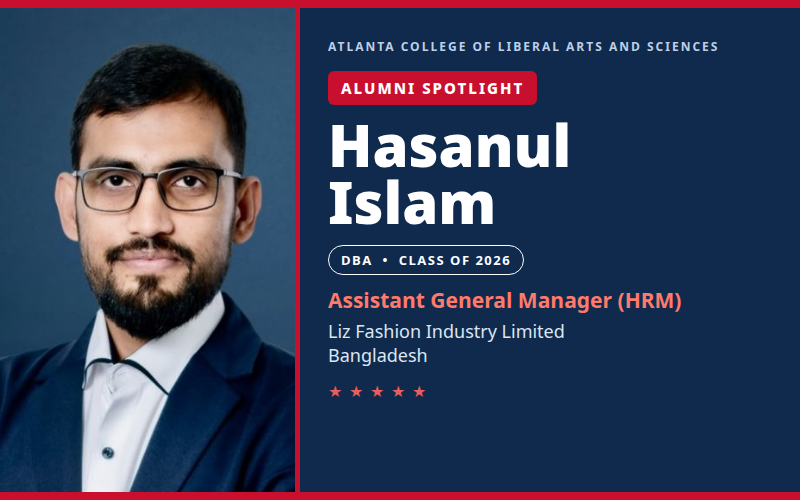
Some careers run deep in one discipline. Hasanul Islam's runs wide. As Assistant General Manager (HRM) at Liz Fashion Industry Limited in Bangladesh, he works across human resources, administration, compliance, sustainability, quality assurance, quality management systems, and operational excellence. He completed his Doctor of Business Administration (DBA) at ACLAS in 2026, adding a doctorate to two MBAs — one in HRM, one in Management. His story is about what further study is for when the student already leads across functions: not a new specialism, but a wider view of the whole.
"Studying at Atlanta College of Liberal Arts and Sciences was an extraordinary chapter of my life. It provided not only academic knowledge but also valuable life lessons, diverse perspectives and unforgettable experiences that continue to shape who I am today."
— Hasanul Islam, DBA, as featured on his Alumni Spotlight poster
Many functions, one standard
The first theme of Islam's story is breadth — and what breadth demands. His own account lists the functions plainly: HR, Administration, Compliance, Sustainability, QA, QMS and Operational Excellence. In a garment factory, none of those is a desk job in isolation. A compliance decision is a people decision; a quality failure is a systems failure; a sustainability target is an operations target. Leading across them means holding one standard while speaking several professional languages.
That is also where his sustainability work sits. He has contributed to Climate Action, Decarbonization, ESG and SDG initiatives within Bangladesh's RMG industry — work that, in his words, drives sustainable business practices and organizational excellence through cross-functional leadership and continuous improvement. In an industry under constant scrutiny for its environmental and social footprint, those words carry weight only if they show up in practice — in how a factory runs and what it changes. His account presents them as operational work, not as a statement of intent — the kind of work where the test is not whether a policy exists, but whether the practice follows.
It is in that context that his account of the DBA makes sense. A doctorate does not teach a working manager a new function. It gives him a framework for the connections between the functions he already leads — and for the judgement calls that sit in the gaps. The academic knowledge mattered, but so did the life lessons, the diverse perspectives, and the experiences that continue to shape who he is today.
Study that keeps shaping the work
The second theme is that learning, for Islam, is a habit rather than a single event. He already held two MBAs before the DBA — in HRM and in Management. A third degree is not a credential chase; it is a deliberate choice to keep studying after the qualifications that would already have been enough. That matters, because the industries he works in do not stand still — and a manager whose learning stopped at the last degree would be managing yesterday's factory.
His account says the study provided diverse perspectives and unforgettable experiences — the kind of learning that comes from a room full of people from other industries and other countries, not from a textbook alone. For a professional whose daily work is cross-functional, that is the point: the value is not only in the content, but in the range of viewpoints it brings into contact with his own. The knowledge and the perspectives continue to shape his work today — a claim that is easy to make and, in his case, backed by the breadth of the work he describes.
For readers considering the same path
If you are a working professional wondering whether further study is realistic alongside a demanding job, Islam's story offers three practical takeaways — not as advice from him, but as what his example demonstrates:
- Lead across functions, not inside one silo. Experience in HR, compliance, quality, and sustainability is worth more together than apart — and study that connects them is worth more than study that deepens only one.
- Let sustainability be operations, not a slogan. Climate action, decarbonization, and ESG only matter when they change how a factory runs. If a policy cannot survive contact with the production floor, it will not survive the working week.
- Keep studying after the qualifications that would be enough. Two MBAs did not end Islam's education; the DBA followed them. For a working professional, the most useful degree is the one aimed at the decisions already in front of them.
None of this makes the path easy. It makes it possible — which, for a working professional, is the real question.
Want to be our next Alumni Spotlight?
Islam's story was first shared on ACLAS's LinkedIn page in July 2026. If you are an ACLAS graduate with a story to share, you can submit yours through the Alumni Spotlight page at spotlight.aclas.college — new graduates are invited to take part, and selected stories will be featured here.
The DBA is $199 one-time (instalments available: Plan A 4 payments of $30, $40, $50 and $79, plus $2 per payment, $207 total; Plan B 2 payments of $60 and $139, plus $2 per payment, $203 total), 14 courses, 210 credits, 1–3 years self-paced and 100% online — see https://aclas.college/programs/dba. Entry needs a master's degree or equivalent and English reading, writing and speaking.
相关阅读
- Alumni Spotlight: William F. McKee — MBA & DBA, Professor, Winston-Salem State University
- Alumni Spotlight: Chase Neil — DBA, Natural & Complementary Health Entrepreneur
- Alumni Spotlight: Rumaizi Bin Ahmad — DBA, NGO Chairperson and District Branch Chairman of Cooperative
原文:Alumni Spotlight: Hasanul Islam — DBA, Assistant General Manager (HRM), Liz Fashion Industry Limited — Atlanta College of Liberal Arts and Sciences
Comments
Post a Comment