Alumni Spotlight: Rumaizi Bin Ahmad — DBA, NGO Chairperson and District Branch Chairman of Cooperative
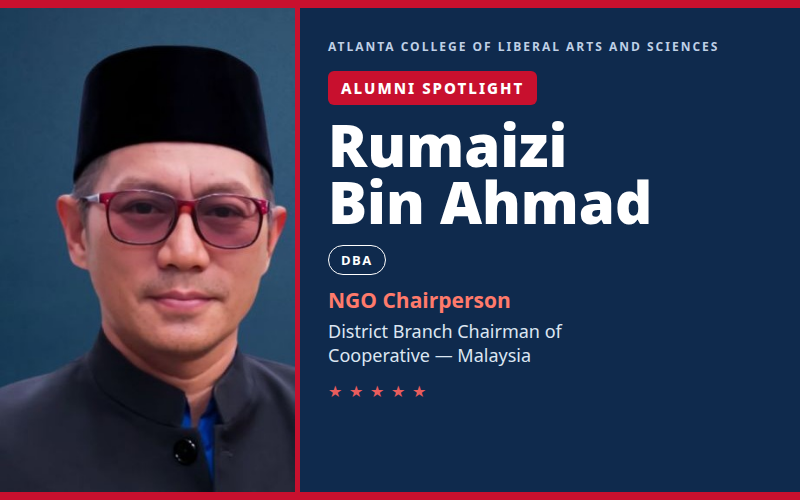
Some students come to a doctorate to change careers. Rumaizi Bin Ahmad came to his with a career already in full flow. The LinkedIn feature that introduced him describes a public-school principal with three decades in education; the poster itself names him NGO Chairperson and District Branch Chairman of a Cooperative. He pursued his Doctor of Business Administration (DBA) at ACLAS in Malaysia while leading across all of those roles at once. His story is about what doctoral study is for when the student has no spare time at all: not a pause from leadership, but a way of leading better inside the schedule he already keeps.
"My experience pursuing the DBA with ACLAS has been profoundly rewarding and transformative. What makes the program truly exceptional is the absolute freedom and flexibility it offers; it allowed me to seamlessly integrate high-level studies into my busy schedule, learning anytime and anywhere without unnecessary pressure."
— Rumaizi Bin Ahmad, DBA, as featured on his Alumni Spotlight poster
Freedom that makes study possible
The first theme of Ahmad's story is the one his own words put first: freedom. Not freedom from work — his account is clear that his schedule is busy — but freedom inside it. The programme's flexibility, he writes, allowed him to integrate high-level study into that schedule seamlessly, learning anytime and anywhere without unnecessary pressure. For a principal who also chairs an NGO and a cooperative branch, that is not a convenience. It is the condition that decides whether study happens at all.
That distinction matters, because flexibility is often sold as comfort and judged as a lack of rigour. His account describes something else: a structure that bends around a working life instead of demanding the working life bend around it. A school does not stop for a study timetable; neither does an NGO, nor a cooperative. What made the programme exceptional, in his words, is that it did not ask him to choose between the study and the work.
He calls the experience profoundly rewarding and transformative — strong words after thirty years in education — and in his telling, that transformation came from studying inside his working life, not from leaving it behind.
Strategic thinking for change in education
The second theme is what that study is for. The LinkedIn feature's theme is strategic thinking and research capability, used for change leadership in education — and that is the natural frame for a principal's doctorate. A school is not a business, but it is an organisation: it has people to lead, resources to allocate, standards to uphold, and a community that judges it by results. Leading change in such a setting takes more than experience. It takes the ability to think strategically about where the organisation should go, and the research capability to tell whether the change is actually working.
That is the work the DBA speaks to. A principal who can frame a problem, gather evidence, and weigh a decision is a different kind of leader from one who runs on habit alone — even after thirty years. The same capacities apply beyond the school gate: chairing an NGO and a cooperative branch means governance, planning, and accountability to people who cannot simply be instructed. Strategic thinking and research are what turn good intentions into decisions that hold up, and decisions into results that can be shown.
His account does not claim the degree did this for him on its own. The change — in how he thinks, and in how he leads — is the work he brought to the programme, and the work he took back out of it.
For readers considering the same path
If you are a working professional wondering whether further study is realistic alongside a demanding job, Ahmad's story offers three practical takeaways — not as advice from him, but as what his example demonstrates:
- Choose a programme that fits the life you already lead. A busy schedule is not an excuse to postpone study — it is the test a programme has to pass. Flexibility that lets you learn anytime and anywhere is what turns a doctorate from an aspiration into something you can actually finish.
- Study for the decisions you are already making. The most useful doctorate for a working leader is one aimed at live questions — strategy, research, and change leadership applied to the school, the organisation, or the community you already serve — not a credential kept for later.
- Let learning serve every role you hold, not just one. A principal, an NGO chairperson, a cooperative chairman — different roles, one judgement. Study that strengthens how you think and decide is worth more than study that deepens only a single job.
None of this makes the path easy. It makes it possible — which, for a working professional, is the real question.
Want to be our next Alumni Spotlight?
Ahmad's story was first shared on ACLAS's LinkedIn page in June 2026. If you are an ACLAS graduate with a story to share, you can submit yours through the Alumni Spotlight page at spotlight.aclas.college — new graduates are invited to take part, and selected stories will be featured here.
The DBA is $199 one-time (instalments available: Plan A 4 payments of $30, $40, $50 and $79, plus $2 per payment, $207 total; Plan B 2 payments of $60 and $139, plus $2 per payment, $203 total), 14 courses, 210 credits, 1–3 years self-paced and 100% online — see https://aclas.college/programs/dba. Entry needs a master's degree or equivalent and English reading, writing and speaking.
相关阅读
- Alumni Spotlight: William F. McKee — MBA & DBA, Professor, Winston-Salem State University
- Alumni Spotlight: Chase Neil — DBA, Natural & Complementary Health Entrepreneur
- Alumni Spotlight: Hasanul Islam — DBA, Assistant General Manager (HRM), Liz Fashion Industry Limited
原文:Alumni Spotlight: Rumaizi Bin Ahmad — DBA, NGO Chairperson and District Branch Chairman of Cooperative — Atlanta College of Liberal Arts and Sciences
Comments
Post a Comment