Alumni Spotlight: Yousa Zariat — DBA, AVP at BRAC Bank, Bangladesh
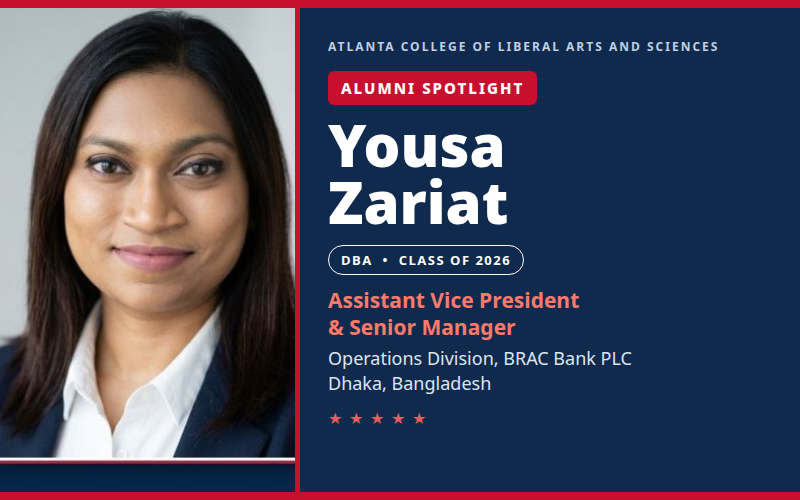
Some doctorates are completed before a career begins. Yousa Zariat's was completed alongside one.
Yousa, a 2026 Doctor of Business Administration (DBA) graduate of ACLAS, is Assistant Vice President and Senior Manager in the Operations Division at BRAC Bank PLC in Dhaka, Bangladesh. Her background is in banking compliance — a field where precision is not a preference but a requirement, and where the cost of getting a process wrong is measured in regulatory exposure, not just in time.
That combination — a senior operations role in a bank, and a doctorate completed while working — is the point of her story. It is also the reason she leads this new Alumni Spotlight column: hers was the most recent alumni post on ACLAS's LinkedIn page, published in late October 2026, and it captures the question working professionals ask most often about doctoral study. Not whether the degree is worth doing, but whether it can be done at all while holding down a demanding job.
"The online learning format provided the flexibility to pursue doctoral-level education while continuing my professional responsibilities. The program enabled me to deepen my understanding of business strategy, leadership, research, and decision-making, while connecting academic concepts with practical challenges from my professional environment. Overall, my experience with ACLAS has strengthened my academic perspective, professional confidence, and commitment to continuous learning and leadership development."
— Yousa Zariat, DBA (as featured on her Alumni Spotlight poster)
Studying for a doctorate while working
The theme of Yousa's LinkedIn feature was flexibility, and it is worth pausing on what that word actually means in her context. Operations in a commercial bank does not run on a student's timetable. Compliance work is deadline-driven, audit-driven, and unforgiving of gaps. A study programme that demanded fixed daytime hours, or a fixed campus presence, would simply not have fitted — however good its content.
Flexibility, in that setting, is not a marketing claim. It is the difference between a programme a working professional can finish and one they have to abandon. Online study, self-paced progress, and the ability to keep working while learning are what make a doctorate accessible to someone already carrying senior responsibility. Yousa's graduation in 2026 is the evidence that the arrangement held: the degree was completed, the career continued, and neither had to be sacrificed for the other.
What leadership development looks like from inside operations
The second theme of her feature was leadership development, and here her operations background matters. Leadership in operations is rarely about grand strategy statements. It is about how decisions get made under pressure, how teams handle exceptions, and how a process that works on paper survives contact with a real working day.
A doctorate does not teach that by itself. What doctoral study can do — and what Yousa's story illustrates — is give a practitioner a structured way to step back from daily operations and examine them: to connect the frameworks of management and research with problems already familiar from the job, and to return to work with a clearer sense of why a process works, not just how it works. That is a quieter kind of leadership development than a promotion announcement, but it is the kind that lasts, because it changes how someone thinks about their work rather than only what title they hold.
For readers considering the same path
If you are working full-time and wondering whether a doctorate is realistic, Yousa's story offers three practical takeaways — not as advice from her, but as what her example demonstrates:
- Fit the study to the job, not the job to the study. A programme that cannot bend around working hours will break first. Check the format before the syllabus.
- Use your workplace as your laboratory. The strongest doctoral work for a practitioner draws on problems already in front of them — operations, compliance, team decisions — rather than invented case studies.
- Measure progress in finished work, not in hours spent. A doctorate completed alongside a career is a long commitment. Steady, verifiable progress matters more than any single intensive week.
None of this makes the path easy. It makes it possible — which, for a working professional, is the real question.
Want to be our next Alumni Spotlight?
Yousa's story was first shared on ACLAS's LinkedIn page in late October 2026. If you are an ACLAS graduate with a story to share, you can submit yours through the Alumni Spotlight page at spotlight.aclas.college — new graduates are invited to take part, and selected stories will be featured here.
The DBA is $199 one-time (instalments available: Plan A 4 payments of $30, $40, $50 and $79, plus $2 per payment, $207 total; Plan B 2 payments of $60 and $139, plus $2 per payment, $203 total), 14 courses, 210 credits, 1–3 years self-paced and 100% online — see the DBA programme page. Entry needs a master's degree or equivalent and proficiency in written and oral English.
相关阅读
- Alumni Spotlight: William F. McKee — MBA & DBA, Professor, Winston-Salem State University
- Alumni Spotlight: Chase Neil — DBA, Natural & Complementary Health Entrepreneur
- Alumni Spotlight: Rumaizi Bin Ahmad — DBA, NGO Chairperson and District Branch Chairman of Cooperative
原文:Alumni Spotlight: Yousa Zariat — DBA, AVP at BRAC Bank, Bangladesh — Atlanta College of Liberal Arts and Sciences
Comments
Post a Comment